
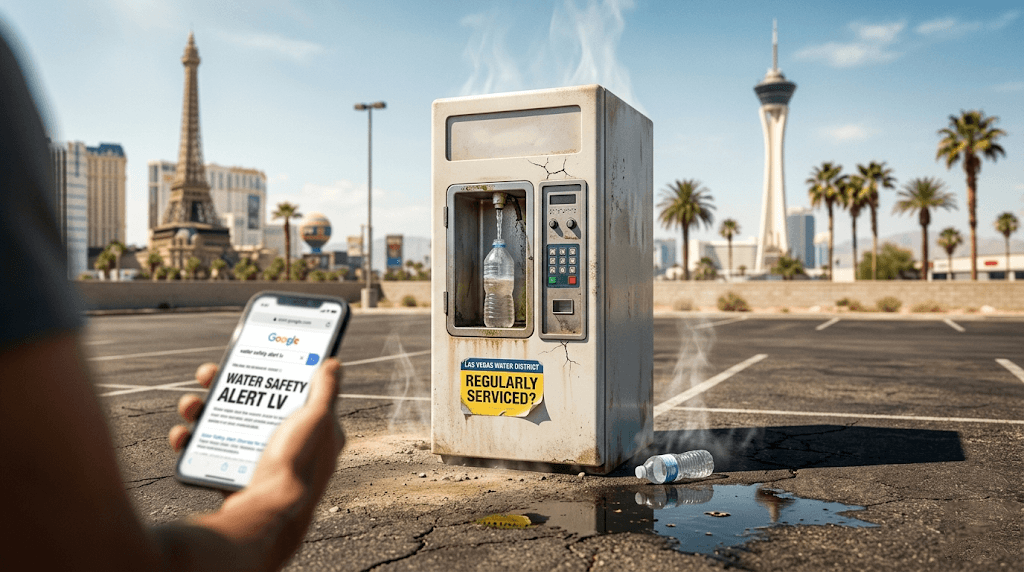
It is 108°F in Las Vegas and you spot a standalone water vending kiosk in a parking lot. You fill up your jug, drive home, and assume all is well. But when was that machine last serviced? When was the nozzle last sanitized? In Las Vegas summer heat, these are not minor questions.
Outdoor water vending machines look clean and convenient. But in Las Vegas (where summer temperatures routinely exceed 115°F) the maintenance demands on outdoor equipment are significant, and most consumers have no way to verify whether those demands are being met.
What Are Outdoor Water Vending Machines?
Outdoor water vending kiosks are coin- or card-operated machines that dispense purified, reverse osmosis, or alkaline water, typically in parking lots outside grocery stores, gas stations, or strip malls. They are common across the Las Vegas Valley and appeal to customers looking for an affordable alternative to bottled water.
On paper they sound practical. In practice, the gap between marketing claims and actual maintenance reality is worth understanding before you rely on them as a primary water source.
The Water Quality Risks of Outdoor Vending Machines
Microbial Growth in Extreme Heat
Water, warmth, and enclosed spaces create conditions where microbial growth can accelerate. NSF International acknowledges that water dispensing equipment that is not regularly sanitized can develop biofilm, a thin layer of microorganisms that clings to internal tubing and components.
In most U.S. cities, outdoor temperatures rarely stress these machines significantly. Las Vegas is different. Asphalt parking lot surface temperatures can reach 140-160°F in July and August. Internal components (tubing, reservoirs, membrane housings) are exposed to radiant heat that indoor equipment never faces. Biofilm growth accelerates at elevated temperatures, making consistent maintenance more critical, not less.
Dispensing Nozzles and Cross-Contamination
The dispensing nozzle is the highest-contact point on any water machine. It is handled by many users throughout the day, exposed to the elements, and in some cases touched directly to jugs or containers. Unlike an indoor staffed facility where equipment is monitored throughout the day, outdoor vending machine nozzles are cleaned only when a service technician visits, which may be monthly, quarterly, or less depending on the operator.
Research on self-service water dispensers has found microbial contamination in a meaningful percentage of machines tested across multiple states. High foot traffic environments with transient populations (like Las Vegas) present elevated maintenance demands that not all operators consistently meet.
Irregular Maintenance and No On-Site Oversight
There is no federal regulatory standard requiring outdoor water vending machines to be inspected or sanitized on a specific schedule. The machines are typically owned and operated by private vending companies. Maintenance is driven by cost and logistics rather than a mandated health standard. Service intervals vary significantly by operator.
When you use a dedicated indoor water store, there is staff on-site, visible filtration equipment, and a direct accountability relationship between the business and its customers. When you use a parking lot kiosk, there is no one watching.
Las Vegas Heat Amplifies Every Risk
Las Vegas averages 70 days per year above 100°F. The Mojave Desert environment creates conditions that place significant stress on water treatment equipment left outdoors without climate controls.
UV radiation degrades plastic components and seals faster, increasing the risk of micro-leaks. Thermal expansion and contraction of tubing accelerates wear. Reverse osmosis membranes operate most efficiently at 55-77°F and performance can degrade significantly above that range. Stagnant water in reservoirs during off-hours in extreme heat creates conditions favorable to biofilm growth. Power fluctuations during Nevada afternoon thunderstorms can disrupt UV sterilization cycles without triggering visible alerts.
These are predictable physical realities of operating water dispensing equipment in the Mojave Desert, not hypothetical edge cases.
What Regulatory Bodies Say About Water Kiosk Safety
NSF International (a leading water filtration certification body) requires certified systems to undergo regular performance testing and sanitation. However, NSF certification at the time of manufacture says nothing about whether a machine is being maintained correctly in the field.
The Nevada Division of Public and Behavioral Health conducts periodic inspections of water vending operations, but with many machines across the state and limited inspector resources, the gap between inspections can be substantial.
The EPA's consumer guidance is straightforward: if you don't know the maintenance history of a water vending machine, treat it as an unknown. For anyone with specific health considerations, verifying a water source's maintenance history before relying on it regularly is a reasonable precaution.
How to Spot a Reliable Water Source: What to Look For
Not all water sources are equal. Here is what to look for and what to avoid.
Concerns at outdoor kiosks: corroded or discolored nozzles, visible residue around the dispensing area, machines that have been in place for years without visible upkeep, no service log posted, machines in full sun without shade or cooling, high foot traffic locations with no visible maintenance contact information.
Positive signs at an indoor water store: visible commercial-grade filtration equipment, trained staff on-site, a clean and climate-controlled environment, transparent maintenance practices, TDS testing, and accountability to a real physical address and business license.
Commercial Indoor Filtration vs. Outdoor Vending Machines
The difference between a commercial indoor water store and an outdoor vending kiosk is structural, not just cosmetic.
Indoor stores maintain consistent temperature ranges that preserve filtration performance. Commercial-grade multi-stage systems are serviced by trained technicians on a regular schedule. TDS testing means water quality is verified before dispensing, not assumed based on a past certification. On-site staff provides direct accountability. Climate-controlled environments protect UV sterilization from the heat and power fluctuations that outdoor machines face regularly in Nevada summers.
Red Rock Springs Water operates commercial-grade filtration equipment inside a climate-controlled facility at 9132 W Sahara Ave. The filtration system is maintained on a more rigorous schedule than industry standard, a commitment to water quality in place since 2012. Alkaline water is TDS tested before each batch is made available. The result is a consistent pH of 9.5+ that customers notice in the taste.
Practical Tips for Safe Hydration in Las Vegas
Whether you are a long-time Las Vegas resident or new to the desert, here are practical steps for consistent, quality hydration.
Choose an indoor staffed water store over an outdoor kiosk whenever possible. Ask any water provider when their equipment was last tested and serviced. A legitimate business will answer directly. Bring clean, capped jugs and rinse them with hot water before refilling. Store refilled water in a cool location, not in a hot car. If you use an outdoor vending machine, inspect the nozzle and surrounding area before use. Consider a 5-gallon jug refill system from a trusted indoor store. It is more economical and provides greater quality assurance than single-gallon kiosk fills.
Where to Get Quality Water Near You in Las Vegas
Red Rock Springs Water at 9132 W Sahara Ave is convenient for residents of Summerlin, Spring Valley, Rhodes Ranch, The Lakes, Peccole Ranch, and the greater west Las Vegas area. The store carries a 4.9/5 Google rating across 190+ reviews and is BBB A+ accredited. Store hours are Monday through Friday 10AM to 6PM and Saturday through Sunday 10AM to 4PM, with 24/7 outdoor vending available for after-hours convenience.
Alkaline water is $1.50 per gallon. Purified reverse osmosis water is $0.40 per gallon. Free curbside loading is available for every customer. Call (480) 721-3918 to confirm current hours or ask about bulk refill options.
When it comes to your family's water, knowing where it comes from and how it is maintained matters. Red Rock Springs Water has been that trusted local source in west Las Vegas since 2003.
Keep reading: our 24/7 refill station, purified RO water at $0.40 per gallon, and the Las Vegas summer hydration guide.